2025 Chinese New Year holiday notice

Chinese New Year Holiday Notice
January 21st - February 5th
SHIPMENT TEMPORARILY SUSPENDED

The Chinese New Year is coming, the freight fowarders and logistics companies will stop working in holiday,  and due to the delivery from our factory to our freight forwarder(Hong Kong) needs 3 ~ 4 days, so we will stop the shipment early. We will temporarily suspend shipment January 21st to February 5th.

Please note:

1. You can still place orders on our website. All orders will be shipped starting from February 6th.

2. Our team will be away during the holiday. We appreciate your understanding and patience.

— OMIOCNC Team
Jan 10, 2025
............
Read more

How to Adjust the Spindle Height When the Tool Cannot Reach the Material

Spindle Height Adjustment for Thin Materials

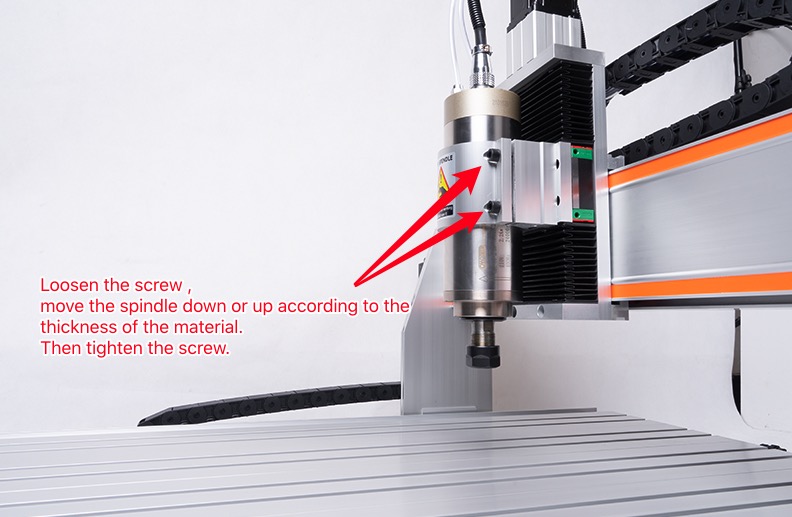
When working with thin materials, the spindle tool may not reach the workpiece surface. There are two easy solutions:

  • Lower the spindle: Loosen the screws on the spindle mount, slide the spindle downward until the tool tip contacts the material surface, then retighten the screws.
  • Add a sacrificial worktable: Place a flat plastic board (such as an acrylic sheet) underneath the material. This raises the workpiece so the tool can reach it, and also protects the machine table from accidental cuts.

Spindle Height Adjustment for Thick Materials

For thicker materials, simply lower the spindle by loosening its mounting screws and moving it downward until the tool reaches the material. No additional support board is usually needed, but always check that the tool has sufficient clearance above the workpiece............

Read more

How to Calculate the Pulse Count for the Planetary‑Geared A‑axis --- AH60‑XX80

Parameters of the AH60‑XX80 A‑Axis

The AH60‑XX80 is a planetary‑geared A‑axis (rotary axis) designed for OMIOCNC routers. To set the correct pulse count in your CNC controller, you need to know three key parameters:

  • Stepper motor step angle: 1.8° per full step, therefore 200 pulses are required for one full motor revolution (200 × 1.8° = 360°).
  • Driver micro‑step setting (default for X8 square‑rail USB machines): 8 micro‑steps per full step.
  • Planetary gear reduction ratio: 10:1 — the motor must turn 10 times to rotate the chuck once.

Calculating Pulses Per Degree (Default 8‑Micro‑Step)

Follow the formula below to calculate how many pulses are required for the chuck to rotate one degree:

Motor full steps per revolution: 200 Micro‑step multiplier: 8 Reduction ratio: 10 Pulses per motor revolution: 200 × 8 = 1,600 Pulses per chuck revolution: 1,600 × 10 = 16,000 Pulses per degree: 16,000 ÷ 360 ≈ 44.444
............
Read more

How to Manage CNC Router Chips and Debris Without a Central Dust Collection System

Why Not to Connect a Standard Vacuum to Your CNC Router

Over the years, many OMIOCNC users have asked whether they can connect a household vacuum cleaner to their desktop CNC router for dust and chip removal. While this seems like a convenient idea, we do not supply parts for such a connection — and here is why.

Reason 1: Insufficient Suction Power

A typical home vacuum cleaner lacks the suction needed to effectively remove debris during routing. Only a dedicated high-power woodworking vacuum (often called a “dust collector”) has enough airflow to capture wood chips as they are produced. Even then, it can only handle lightweight wood dust — it cannot reliably pick up metal chips or heavier particles. Using an undersized vacuum will quickly clog the hose and reduce cutting performance.

Reason 2: Unbearable Noise Levels

Woodworking vacuums are extremely loud. A machining session may last anywhere from tens of minutes to several hours. Running a high-decibel vacuum continuously creates noise that is not only unpleasant for you but also likely to disturb your neighbors — unless you have a separate, well-Soundproofing............

Read more

2024 Chinese National Day holiday notice

National Day Holiday Notice
September 29 – October 6
SHIPMENT TEMPORARILY SUSPENDED

The Chinese National Day is coming. We will temporarily suspend shipment from September 29th to October 6th.

Please note:

1. You can still place orders on our website. All orders will be shipped starting from October 7th.

2. Our team will be away during the holiday. We appreciate your understanding and patience.

— OMIOCNC Team
Sep 27, 2024
............
Read more

How to Prevent Milling Cutter Damage

How to Prevent Milling Cutter Damage?

Maintaining your milling cutters is essential for achieving high-quality results and extending tool life on your CNC router. Here are the common causes of damage and how to solve them.

Cause of damage

  1. Speed too slow, feed rate too fast.
  2. Workpiece installation unstable.
  3. Tool overhang too long, clamping part too short.

Resolvent

  1. Increase speed or reduce feed rate.
  2. Improve fixtures to ensure workpiece is stable.
  3. Minimize overhang, keep clamping area 4 times or more.

… … …............

Read more

VFD Error Codes Troubleshooting Guide

VFD Error Codes Troubleshooting Guide

This guide lists common VFD (Variable Frequency Drive) fault codes, their possible causes, and countermeasures to help you quickly diagnose and resolve issues with your CNC router.

Fault Code Fault Type Possible Cause Countermeasure
Err02 Acceleration overcurrent 1. Too short acceleration time
2. Low voltage
3. Small frequency converter selection
1. Increase acceleration time
2. Set the voltage to the normal range
3. Frequency converter power increase
Err03 Deceleration overcurrent 1. Too short deceleration time
2. Low voltage
............
Read more

Controller Upgrade Notice – X8‑2200L‑USB / X6‑2200L‑USB Models

Controller Upgrade Notice
Effective Date: August 15, 2024 Important Update

The controller for X8‑2200L‑USB / X6‑2200L‑USB models has been upgraded.

Please note:

1. Units manufactured after August 15, 2024 are equipped with a new USB motion control card that offers better performance, greater stability, and stronger anti‑interference capability.

2. Customers who purchased these two models after August 15, 2024 should use the new DLL file sent with their machine (usually included in the settings ZIP package).

3. Users of older controllers should continue using the previous DLL configuration files.

............
Read more

How to Choose CNC Router Bits

Choosing the right bit is one of the most fundamental yet error-prone steps in CNC machining. An unsuitable bit not only compromises part quality but can also cause breakage, burning, or even spindle damage. This guide breaks down the selection logic into five aspects: geometry, coating, flute count, shank size, and material compatibility.

1. Bit Geometry: Match the Feature

Different tasks require different cutter shapes. Below are the most common types and their applications:

Bit Type Visual Feature Best For
End Mill Flat bottom, spiral flutes Roughing, contour cutting, surfacing
Ball Nose Hemispherical tip 3D relief, curved surfaces, chamfering
V‑Bit V‑shaped tip (30°, 60°, 90°)
............
Read more

How to Prepare a Secondary Work Table for CNC Router

Many beginners overlook a simple yet highly practical accessory: a secondary work table. This is an independent backup panel, typically made of thin aluminum plate, phenolic resin board, or HDPE, mounted on the main work table via T‑slots or clamps. Why do experienced users almost always keep one? Here are four real‑world benefits.

1. Protect Your Main Table, Reduce Maintenance Costs

Once the main work table (especially an aluminum T‑slot surface) is accidentally cut, drilled, or gouged by a cutter, repairing it is troublesome. Even minor scratches can affect workpiece flatness. A secondary table is designed to be sacrificial — it can be machined, drilled, even milled through. When its surface becomes too worn, simply replace the backup board at a fraction of the cost of repairing or replacing the main table.

2. Easier and Safer Small‑Part Clamping

Clamping small workpieces directly onto the main table is often difficult because the T‑slot spacing is too wide for the clamps to align with the part edges. With a secondary table, you can pre‑drill locating holes anywhere, then fix the small workpiece using screws or double‑sided tape............

Read more
To Top
Home
Menu
Shop
Account
0 Cart